Loan Affordability: The Number Your Bank Checks vs. The Number You Should Check
Banks approved your loan. That doesn't mean you can afford it.
This is the gap that puts thousands of Indian borrowers under financial stress every year — not because they borrowed too much in absolute terms, but because no one helped them calculate what their monthly cash flow would actually look like after the EMI kicks in.
Here's how to do the math properly, before you sign.
What Banks Check: The FOIR
Banks use a metric called FOIR — Fixed Obligation to Income Ratio. It measures what percentage of your gross monthly income is already committed to loan repayments.
FOIR formula: (Total monthly loan obligations ÷ Gross monthly income) × 100
Most banks approve loans when FOIR is below 50–55%. So if your income is ₹80,000 per month and you already pay ₹15,000 in car loan EMI, the bank will typically approve an additional EMI up to ₹25,000–29,000 (keeping total obligations below 55%).
But here's what FOIR doesn't account for: your actual take-home income, household expenses, insurance premiums, or anything that happens between your salary credit and the first of the month.
What You Should Actually Check: The 30% Rule
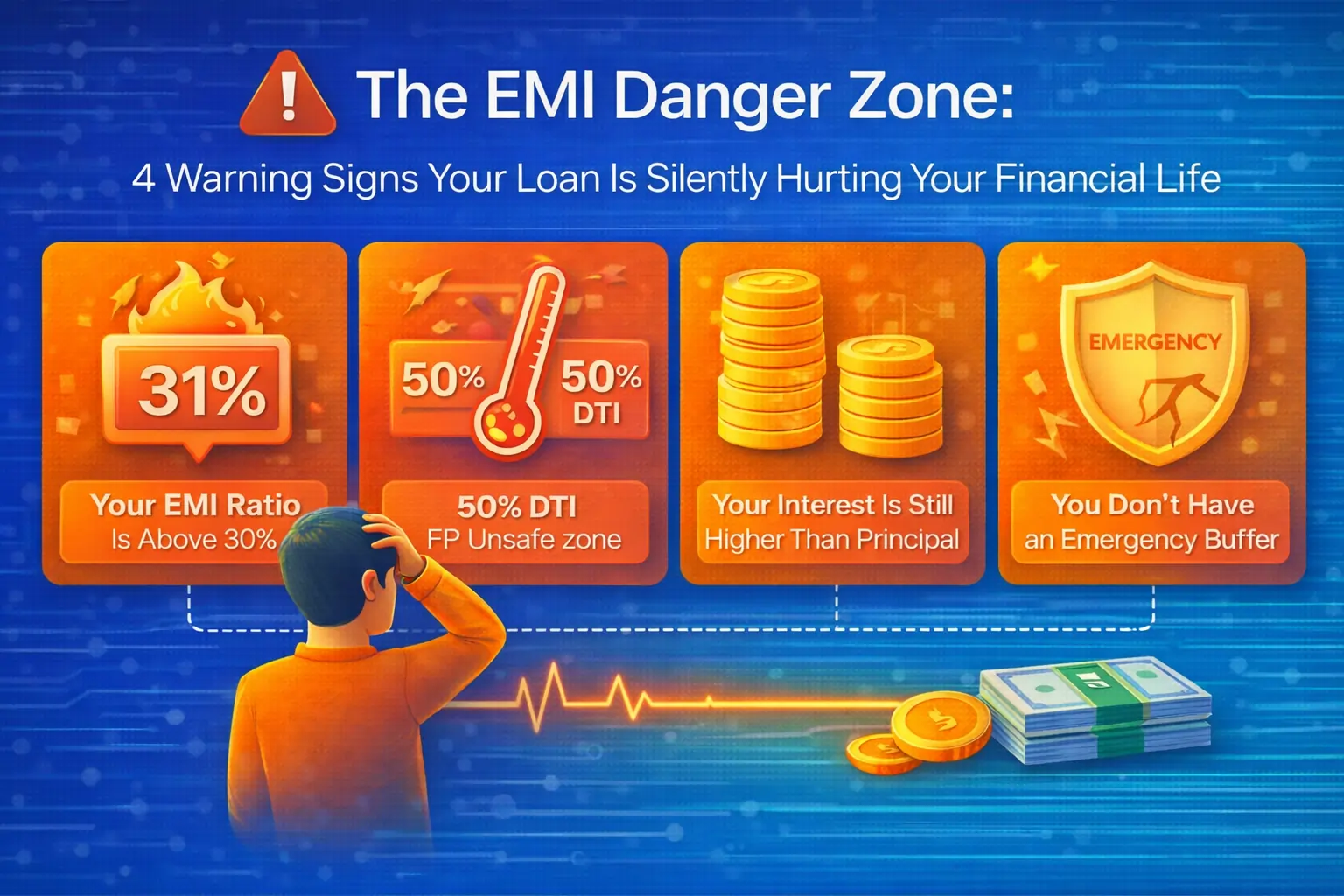
Financial planners widely recommend the 30% rule for home loans: your total home loan EMI should not exceed 30% of your net (take-home) income. For all loans combined, stay under 40%.
| Monthly Take-Home | Max Home Loan EMI (30%) | Max All EMIs (40%) |
|---|---|---|
| ₹50,000 | ₹15,000 | ₹20,000 |
| ₹75,000 | ₹22,500 | ₹30,000 |
| ₹1,00,000 | ₹30,000 | ₹40,000 |
| ₹1,50,000 | ₹45,000 | ₹60,000 |
Cross this threshold and you're not in financial disaster territory immediately — but you've eliminated all margin for error. One medical emergency, a delayed salary, a car repair, or a family obligation will put you in a position where the EMI and the expense both land in the same month.
The Hidden Costs Banks Don't Factor In
For home loans specifically, the EMI is just one part of the monthly cost of ownership. A ₹60 lakh home loan EMI of ₹49,000 per month at 8.5% looks manageable on paper — but add these actual costs:
- Society maintenance charges: ₹3,000–8,000/month depending on the project
- Property tax: ₹500–2,000/month (varies by city and property value)
- Home insurance: ₹500–1,500/month
- Repairs and maintenance reserve: Financial planners recommend 1% of property value annually — ₹5,000/month for a ₹60 lakh property
That's an additional ₹9,000–16,000 per month on top of the EMI. The real cost of ownership is 18–30% higher than the EMI alone.
The Rate Stress Test
Most home loans in India are floating-rate loans linked to REPO rate or MCLR. When the RBI raises rates — as happened multiple times between 2022 and 2024 — your EMI or tenure increases without warning.
Before committing to a loan, run this simple stress test: Can you afford the EMI if the interest rate goes up by 2%?
On a ₹50 lakh loan at 8.5% over 20 years, the EMI is ₹43,391. At 10.5%, it jumps to ₹49,959 — an extra ₹6,568 per month. If that extra amount would strain your budget, you're already at the edge of your affordability.
The Emergency Fund Requirement
A loan you can afford today becomes unaffordable during a job loss or income disruption if you have no buffer. The standard recommendation: keep 6 months of EMI + essential expenses in a liquid account before taking a large loan.
If building that buffer requires waiting 8 months, wait. It's not pessimism — it's the difference between a loan being a financial tool and a financial trap.
Calculate Your True Affordability First
Before you decide on a loan amount, tenure, or even which bank to approach — calculate what EMI you can genuinely afford based on your actual monthly cash flow, not your gross income.
Use the Home Loan EMI Calculator to work backwards: enter the EMI you can comfortably manage, and see what loan amount that corresponds to at current rates. That's the number you should borrow — not the maximum the bank will approve.
Bank approval is a credit decision. Affordability is a personal finance decision. Only one of them determines whether the next 20 years are financially stable or financially stressful.
Topics Covered
Authoritative Sources & References
Team GearsKit
Verified AuthorTeam GearsKit covers personal finance, EMI planning, income tax, and investment strategies for Indian earners. Content is grounded in RBI guidelines, SEBI regulations, and standard financial methodology — written to help real people make clearer money decisions.